




















Spring School 2026 in Pisa: Applications Open for Criminal Law and the Anthropocene (Funded)
Applications are open for the 2026 Spring School on Criminal Law and the Anthropocene in Pisa, with free participation for selected master’s students, PhD candidates, and early career researchers.
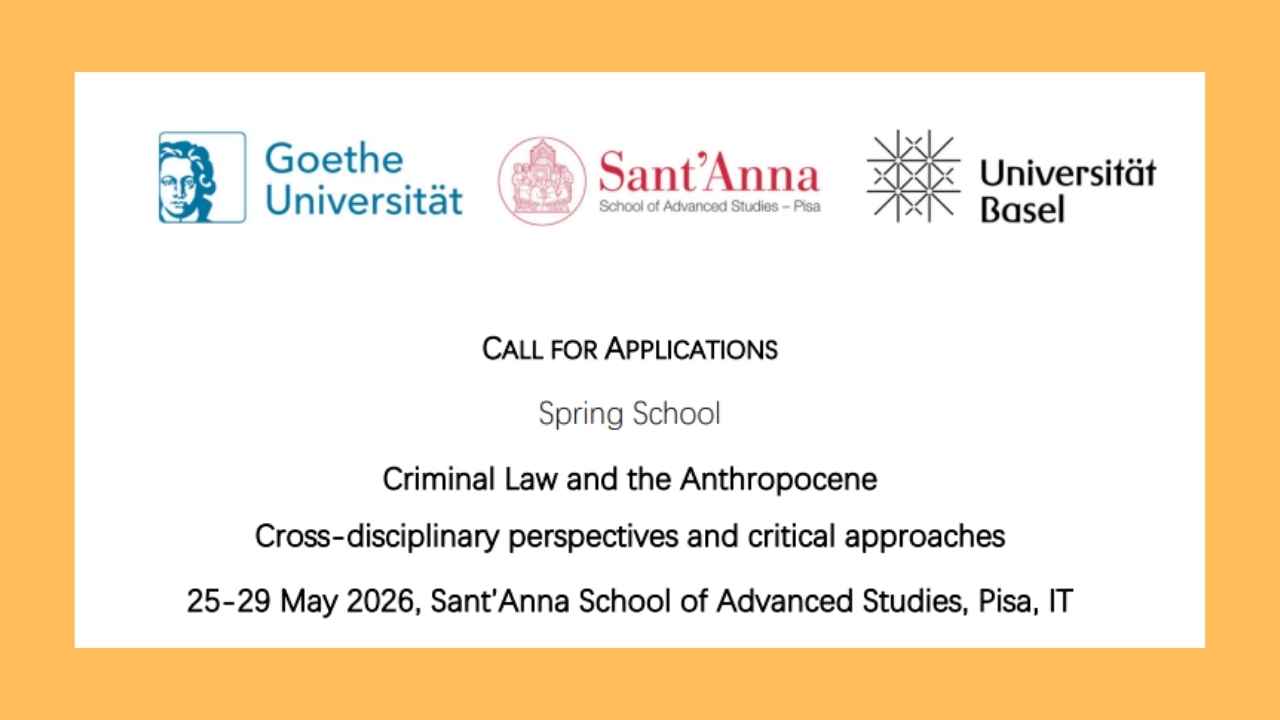
Sant’Anna School of Advanced Studies Pisa, in partnership with Goethe University Frankfurt am Main and the University of Basel, has officially opened applications for the Spring School on Criminal Law and the Anthropocene: Cross-disciplinary Perspectives and Critical Approaches. The programme will take place from 25 to 29 May 2026 in Pisa, Italy. Applications are open until 9 March 2026.
The Spring School is funded by the European Union and supported by Erasmus+, ENGAGE Green, C3S – Center for Critical Computational Studies, and ZLSR – Zentrum für Life Sciences-Recht.
About the Programme
The Spring School examines how the Anthropocene — the idea that human activity now shapes the Earth at a geological scale — challenges the foundations of criminal law.
First introduced in 2000 by Paul Crutzen and Eugene Stoermer, the Anthropocene describes a proposed geological epoch in which humanity acts as a force influencing the atmosphere, biosphere, hydrosphere, and lithosphere. The concept has reshaped debates across science, philosophy, and law.
This programme focuses on what this shift means for criminal law. If environmental harm becomes planetary, long-term, and interconnected, how should legal systems respond? What happens to concepts such as responsibility, causation, punishment, legitimacy, and justice?
Academic Structure and Thematic Streams
The Spring School offers a 40-hour intensive residential programme delivered over five days. It is structured around three core streams:
-
Interdisciplinary Perspectives on the Anthropocene
-
Fundamentals of Law in and for the Anthropocene
-
Criminal Law in and for the Anthropocene
The programme brings together leading scholars and experts who will engage participants through lectures, keynote addresses, thematic panels, and structured academic discussions.
Key areas of focus include:
-
The challenge the Anthropocene poses to liberal and anthropocentric foundations of criminal law
-
Rethinking theories of criminalization, punishment, and legitimacy
-
Integrating scientific, philosophical, socio-legal, and empirical approaches into criminal law
-
Reconsidering criminal responsibility, attribution, causation, and mens rea in cases of environmental harm
-
Intergenerational justice and climate criminal law
-
The impact of planetary change on international criminal law, ecocide debates, atrocities law, and global governance
Writing Workshops and Research Development
A central component of the Spring School is its research workshop model.
Selected participants will present draft papers related to the programme’s themes. These papers will be discussed in structured group sessions, following a defined methodology. Participants will receive detailed feedback from faculty and peers to help strengthen their research.
Selected participants must submit a draft paper (maximum 8,000 words) by 20 May 2026.
Eligibility Criteria
The programme is open to:
-
Master’s graduates or students completing a master’s degree
-
PhD candidates
-
Early Career Researchers who obtained their PhD within the last five years
Selection Process and Limited Seats
The Spring School can accommodate a maximum of 25 participants.
Due to the limited number of seats, a competitive selection process will be conducted by the scientific committee of the Spring School. The selection process follows principles of inclusivity and equality upheld by the organizing universities.
All applicants will be notified of the outcome by 16 March 2026.
Application Requirements
Applicants must submit:
-
A CV (maximum 2 pages)
-
An abstract (maximum 500 words, excluding footnotes and bibliography) aligned with the Spring School’s thematic framework
-
A motivation letter (maximum 2 pages) explaining how the programme supports their research
Applications must be submitted by email to:
[email protected]
Application Deadline: 9 March 2026
Funding and Participation Costs
Participation in the Spring School is free for selected participants.
The programme is funded by the European Union and supported by Erasmus+ and partner institutions. However, travel and accommodation costs are not covered. Organizers may provide logistical assistance where possible.
Why This Spring School Matters
The Anthropocene is more than a scientific label. It reshapes how we understand responsibility, harm, justice, and governance. Criminal law, traditionally built around individual actors and clear causal chains, now faces environmental harms that unfold across borders and generations.
For researchers working at the intersection of criminal law, environmental law, philosophy, and global governance, this Spring School offers a focused and rigorous space for debate, collaboration, and research development.
May 2026 in Pisa will bring together 25 scholars to examine how criminal law must evolve in an age defined by planetary change.
For More Opportunities Please Follow Our Whatsapp Channel
What's Your Reaction?
 Like
0
Like
0
 Dislike
0
Dislike
0
 Love
0
Love
0
 Funny
0
Funny
0
 Angry
0
Angry
0
 Sad
0
Sad
0
 Wow
0
Wow
0